How long can you stay awake before your body fails? While individual tolerance varies, sleep research consistently demonstrates that cognitive performance and physical coordination degrade sharply as hours awake accumulate. This is not just a matter of subjective fatigue, but a physiological impairment that directly affects brain functions, particularly in the prefrontal cortex.
Specifically, the landmark study by Dawson & Reid (1997) scientifically proved that the cognitive decline caused by sustained wakefulness is extremely similar to the physical and mental impairment that occurs with rising blood alcohol concentration (BAC).
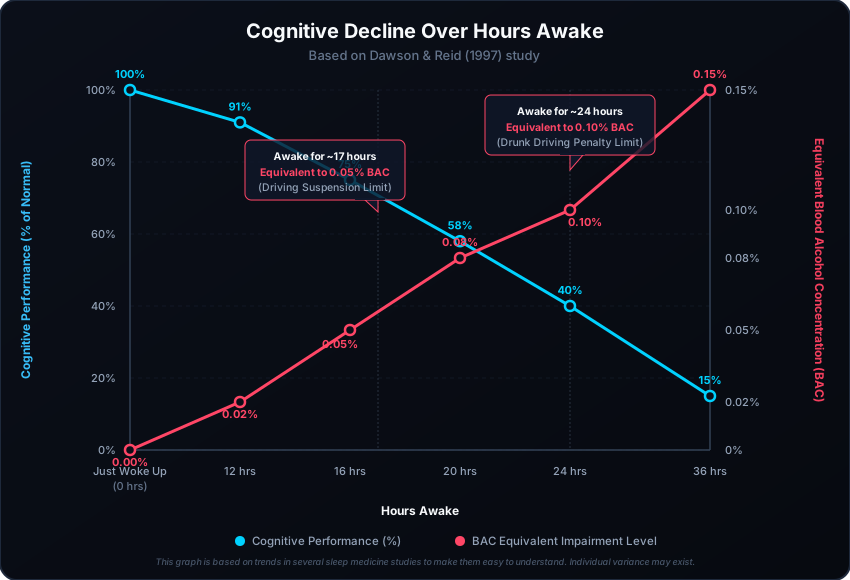
※ This graph is simplified based on several sleep medicine studies to make the trend easy to understand. Individual variance may exist.
Scientific Findings from the Study
In the Dawson & Reid (1997) study, researchers restricted sleep in 26 healthy adults and monitored them under continuous wakefulness while periodically testing their computer-based cognitive and psychomotor performance. They measured response latency, sustained attention, and hand-eye coordination, and compared the results to data from the same group under the influence of alcohol.
The results were striking: after 17 hours of wakefulness, the participants' cognitive decline was statistically identical to a BAC of 0.05%. Furthermore, after 24 hours of sustained wakefulness, their brain function matched the impairment level of a BAC of 0.10%.
This delivers a severe warning: even if you haven't consumed a single drop of alcohol, being awake for 24 hours leaves you with the same physical and cognitive impairments as a legally intoxicated driver.
Stages of Physical and Cognitive Decline over Hours Awake
A detailed breakdown of performance loss relative to wakefulness duration includes:
- Right After Waking (0 to 12 Hours): Cognitive performance begins at 100% and maintains around 91%. This is a normal baseline stage suitable for complex tasks and clear conversations. (Equivalent BAC under 0.02%).
- 17 Hours of Awake (Threshold): Cognitive performance drops to approximately 75%. This is functionally equivalent to a BAC of 0.05%, the legal limit for driving suspension in many countries. Reaction times slow down significantly, and minor judgment errors begin to manifest.
- 20 Hours of Awake: Performance declines to 58%, matching the impairment of a person with a BAC of 0.08%. Information processing slows, and short-term working memory limits become apparent.
- 24 Hours of Awake (Equivalent to Intoxication): Cognitive performance collapses to about 40%, matching a BAC of 0.10%, the legal limit for drunk driving prosecution and license revocation. Microsleeps (involuntary blackouts lasting 1 to 5 seconds) start occurring, drastically increasing the risk of catastrophic accidents.
- 36 Hours of Awake: Cognitive capacity drops below 15%. Prefrontal executive control is virtually offline, often causing severe disorientation, sensory distortions, memory lapses, and mild hallucinations.
Crucial Warnings: Things to Remember
Losing one night of sleep does not permanently damage your health, as the body's homeostatic systems temporarily adapt to survive acute sleep debt.
However, as hours awake pile up, the neural fatigue compounds exponentially. Reaction times, focus, and critical thinking fail. Sleep-deprived driving is as dangerous as—or even more dangerous than—drunk driving because it completely paralyses judgment. If you face schedules requiring high vigilance—such as driving, medical procedures, or major business decisions—you must manage your wakefulness strictly and prioritize recovery.
🔬 SleepLab2 Conclusion
According to sleep science, sleep deprivation is not a matter of fatigue; it is a physical emergency that limits cognitive processing speeds in the prefrontal cortex. 17 hours of wakefulness corresponds to a BAC of 0.05%, while 24 hours awake causes impairments equivalent to a BAC of 0.10%.
Believing you can overcome sleep loss through mental toughness or willpower is a myth. Tracking your awake hours and obtaining recovery sleep before severe deficits occur is the only way to protect safety and brain health. SleepLab2 identifies these circadian mechanisms to help you design a sustainable, healthy life.
📚 References & Academic Literature
- Dawson, D., & Reid, K. (1997). Fatigue, alcohol and performance impairment. Nature, 388(6639), 235-235. doi:10.1038/40728
- Williamson, A. M., & Feyer, A. M. (2000). Moderate sleep deprivation produces impairments equivalent to legally prescribed levels of alcohol intoxication. Occupational and environmental medicine, 57(10), 649-655.
- Goel, N., Rao, H., Durmer, J. S., & Dinges, D. F. (2009). Neurocognitive consequences of sleep deprivation. Seminars in neurology, 29(4), 320-339.